

Planetary Health
Dr. Ryznar leverages her expertise as a physician and professor to provide clear, engaging, and evidence-based information about how excessive plastic harms ecosystems and human health. Her work centers around three themes:
Advocating for policy and business solutions
Providing education about plastics and health
Researching how plastics impact the brain
She also has expertise in planetary health topics more broadly. She is available for consultancies.
Solutions
Articles:
We’ve Heard “Safe” Before: New York Should Lead on PFAS
Published in New York state Newspapers: Times Herald-Record, Daily Messenger, The Leader, Times Telegram, The Observer-Dispatch, Democrat and Chronicle, Press & Sun-Bulletin, The Star Gazette, The Ithaca Journal, Poughkeepsie Journal, and The Journal News/LoHud, 8/20/2026 (with Jane van Dis and Megan Wolff)PFAS (per- and polyfluoroalkyl substances) are associated with cancer, immune suppression, thyroid disease, fertility problems, developmental harms, and metabolic dysfunction. They persist in the environment for decades (earning the moniker “forever chemicals”) and accumulate in our bodies over time. Nearly every American now carries PFAS in their blood (our pets have them, too). Yet despite mounting scientific concern, industry groups continue to insist that these products are already “safe,” particularly when it comes to nonstick cookware. Their arguments deserve scrutiny.
New Dietary Guidelines Neglect The Health Risks Of Food Processing And Packaging
Health Affairs Forefront, 3/23/2026 (with Michael Shank)
The recently updated dietary guidelines for Americans, released this January by the Department of Health and Human Services (HHS), rightfully emphasize whole foods over ultraprocessed foods. But the guidelines neglect to address how that food is delivered. “Real food” can still cause chronic disease if it contains harmful chemicals lingering from processing or packaging. Congress and federal agencies should commit to ensuring that all Americans have access to safe real food by strengthening federal oversight of chemicals in food processing and packaging.Treaty failure is not the end of the fight against plastic pollution
Al-Jazeera Opinion, 8/21/2025 (with Michael Shank)
As global plastic treaty talks end in failure, with no agreement, all is not lost in the global momentum to cut plastic pollution. United States lawmakers recently introduced the Microplastics Safety Act, for example, mandating the Department of Health and Human Services to study microplastics exposure and health impacts. The bill reflects growing concern in Congress about the plastics health crisis and the broad bipartisan support to address it. However, given that plastic production, use, and hence exposure, continue to increase every year, we should not wait idly for the US report’s findings or more failed global plastic treaty talks. There is enough evidence to take action now. In this article, we highlight three areas that can help reduce everyone’s exposure to microplastics: culture, business and policy.
Testimony and Briefings:
Provided oral testimony as a medical expert in support of the Maryland Container Recycling Refund and Litter Reduction Program to the Montgomery County Delegation on 11/18/24, the Maryland House of Delegates on 2/14/25 and 2/11/2026, and the Maryland Senate on 2/18/25 and 2/10/2026
Provided written testimony in support of the Maryland Container Recycling Refund and Litter Reduction Program in 2025 and 2026, obtaining endorsement from several medical and public health organizations for the letter.
Featured speaker at a rally in support of the Maryland Bottle Bill in Annapolis on 2/14/2024
Co-authored “Plastic Pollution and Producer Responsibility,” a brief prepared by Environment Virginia and other organizations to inform 2026 Virginia state policy discussions
Medical Expert:
Lead author for the American Psychiatric Association’s position on Single-Use Plastics (forthcoming). The American Psychiatric Association is the world’s largest psychiatric organization, with over 40,000 members from 100 countries. The official statement reads:
“Based on research evidence that shows the negative neurobiological and developmental effects of plastics, with potential long-term neuropsychiatric consequences, the production and use of single-use plastics should be reduced while research continues.”
Quoted in Ocean’s campaign for the “Farewell to Foam” Act:
“I became a doctor because I wanted to ensure that all people had the opportunity for a healthy and dignified life. Unfortunately, plastic pollution undermines this goal. For example, expanded polystyrene foam is made with a cancer-causing chemical. That is why I am proud to support the Farewell to Foam Act. This bill phases out expanded polystyrene from single-use food packaging, packing peanuts, and coolers, allowing safer products on the market. Twelve states have already enacted similar laws reducing plastic foam, and now it’s time to safeguard the health of all Americans from this hazardous pollutant.”Panelist for Oceana’s webinar about plastic foam for state legislators (January 2026)
Communications
Community Outreach:
Developed a “Plastics and Health” handout that can be used at community events or health clinics.:
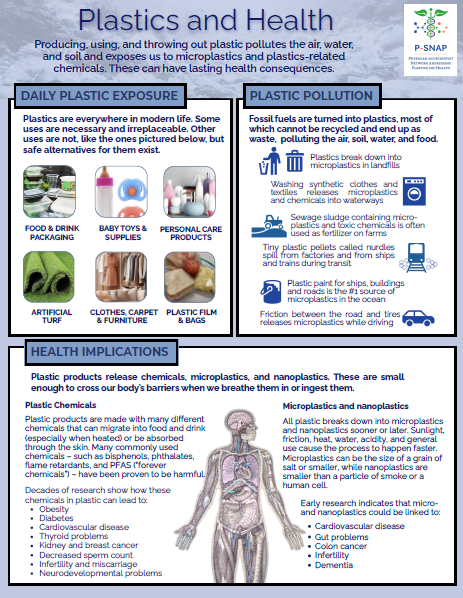
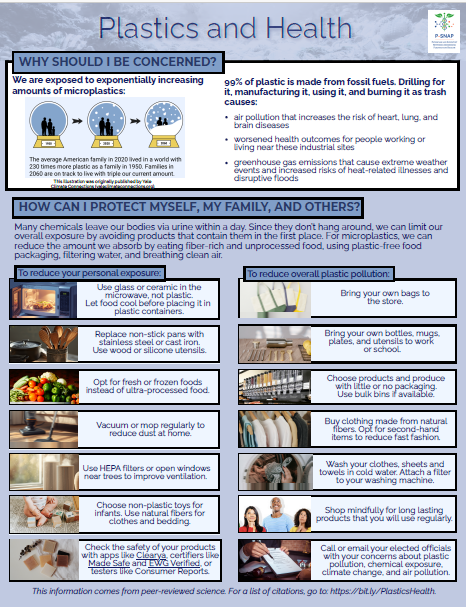
Spoke on multiple panels addressing plastics and health, with a combined audience of 200 community members:
Children’s Environmental Health Day virtual presentation by Maryland Healthy Climate on 10/10/2024
Premiere of “Single-Use Planet” documentary by PBS and Habitat Media film on 4/9/2025
Maryland Bottle Bill Coalition presentation with Patagonia’s Baltimore store on 9/11/2025
Webinar on plastics in healthcare hosted by Greenwell Project on 7/6/2026
Webinar on “The Impacts of Plastic Pollution” hosted by Environment Virginia, Environment North Carolina, and Environment Georgia on 7/15/2026
Invited guest for the Beyond Plastics Volunteer Group Monthly Meeting (60 attendees)
Medical Audiences:
Published the first psychiatric article discussing how plastic pollution impacts the brain, featured as the cover story for Psychiatric Times’ 9/2024 issue.
Appointed to the American Psychiatric Association’s Committee on Climate Change and Mental Health for 2026-2027 in order to address the impacts of plastics on mental health
Introduced a plastics-related metric for the 2027-2028 version of the Planetary Health Report Card, a student-driven initiative to assess how well allied health professionals schools teach planetary health
Featured speaker by the American Psychiatric Association in their “emerging topics” series on 8/4/2026
Invited lecturer at 10 Psychiatry Departments at medical schools like Tufts, University of Nebraska, and Virginia Tech (combined audience of >900 psychiatrists, psychologists, social workers, and medical students) and 7 international neuropsychiatric or climate health groups (combined audience of >240 doctors, nurses, and other health professionals) since 12/2024
Invited guest for the Climate Psychiatry Alliance podcast (episode forthcoming).
Keynote speaker for the American Psychiatric Association’s District 1 Branch Annual Meeting on 4/17/2025 for psychiatrists in Toronto
Invited speaker for the Alzheimer’s Association Neuroscience Next Meeting in Costa Rica on 2/24/2026 (>120 attendees)
Advisory Board Member to the Physician and Scientist Network Addressing Plastics and Health (P-SNAP)
Introduced planetary health to a clinical audience via a monthly “Climate Corner” for Maryland Psychiatric Society 2024-2025 and for the general public via Sheppard Pratt’s website (on heat and plastics)
Media mentions:
“We do know that levels of micro- and nanoplastics are increasing drastically on the planet. So it’s reasonable to assume that our dose of exposure will increase too.” Quoted in “A scientist questioned new microplastics findings. Then other researchers fired back.” by Shannon Osaka, Washington Post, 1/17/2026
“Personal choices matter, but the scale of this problem requires policy and industry action. That means curbing unnecessary single-use plastics and capping overall production growth, while also investing in safer materials and reformulating additives to avoid endocrine disruptors. Setting standards for microfiber filtration in washing machines and for tire-wear particles would make a major difference, as would procurement changes in hospitals, schools, and cities to reduce plastic waste at the source. Clearer labeling and greater transparency are also essential so that consumers and clinicians can make informed choices. Finally, civic engagement truly works; asking local, state, and national representatives what they’re doing about plastics and health helps build the political will needed to act.” Interviewed by Burcin Ikiz for Psychology Today, 10/15/2025
“The microplastics research is really early, but I’m a firm believer in the precautionary principle. Our exposure is growing exponentially. We don’t want to wait 30 years for definitive proof – by then it’ll be too late and too many people will be harmed.” Quoted in: “What are the health impacts of plastics?” by Neha Pathak, Yale Climate Connections, 5/1/2025
“The triangle with the infinite loop was designed to make us think everything’s recyclable. They’re using psychology against us to increase profits.” Quoted in: “How to reduce microplastic exposure and protect your health” by Neha Pathak, Yale Climate Connections, 5/1/2025.
Research
Current Projects:
Assembled an international team of 11 physicians and researchers to systematically review the scientific evidence how microplastics affect the brain (project 75% complete)
Manuscript describing the four mechanisms by which plastics harm brain health currently under submission
Publications:
The plastics crisis: a neuropsychiatric problem hidden in plain sight.
Psychiatric Times 2024; 41(9): 13-16. Selected as the cover story for the September issue
Authors: Ryznar E, Haase E, Lauterbach M.American Psychiatric Association Lifestyle Psychiatry Presidential Workgroup Report.
American Journal of Psychiatry; 2025; 182(9), 885‑887. https://doi.org/10.1176/appi.ajp.25182005
Authors: Merlo G, Porter‑Stransky KA, Sugden SG, Roy K, Hirschberg A, Smalls‑Mantey A, Agrawal A, Bahekar P, Beck JL, Bhatia R, Buckholz A, Colon‑Rivera HA, Carroll NA, Carey T, Fung WLA, Hopper K, Ijeaku I, Lee W, Madaan V, Nagarajan R, Penumetcha V, Pereira‑Sanchez V, Patel AK, Raju N, Ridout KK, Ridout SJ, Ryznar E, Somers JC, Taneja K, Verma D, Wong WT, Viswanathan R, Baron D.Climate-related and nature-based interventions for mental health: an umbrella review and meta-analysis.
JAMA Psychiatry, 2026: online first doi:10.1001/jamapsychiatry.2026.0037
Authors: Brandt L, De Prisco M, Nocera D, Rehm MC, Cohen S, Kosker DN, von Luxburg S, Ori D, Pinzón-Espinosa J, Scheuber P, Sonntag N, Radua J, Hasan A, Luykx, and the Global Evidence on Planetary Mental Health Study Health Group.